
Lean
Personalize This
Get insights for your role
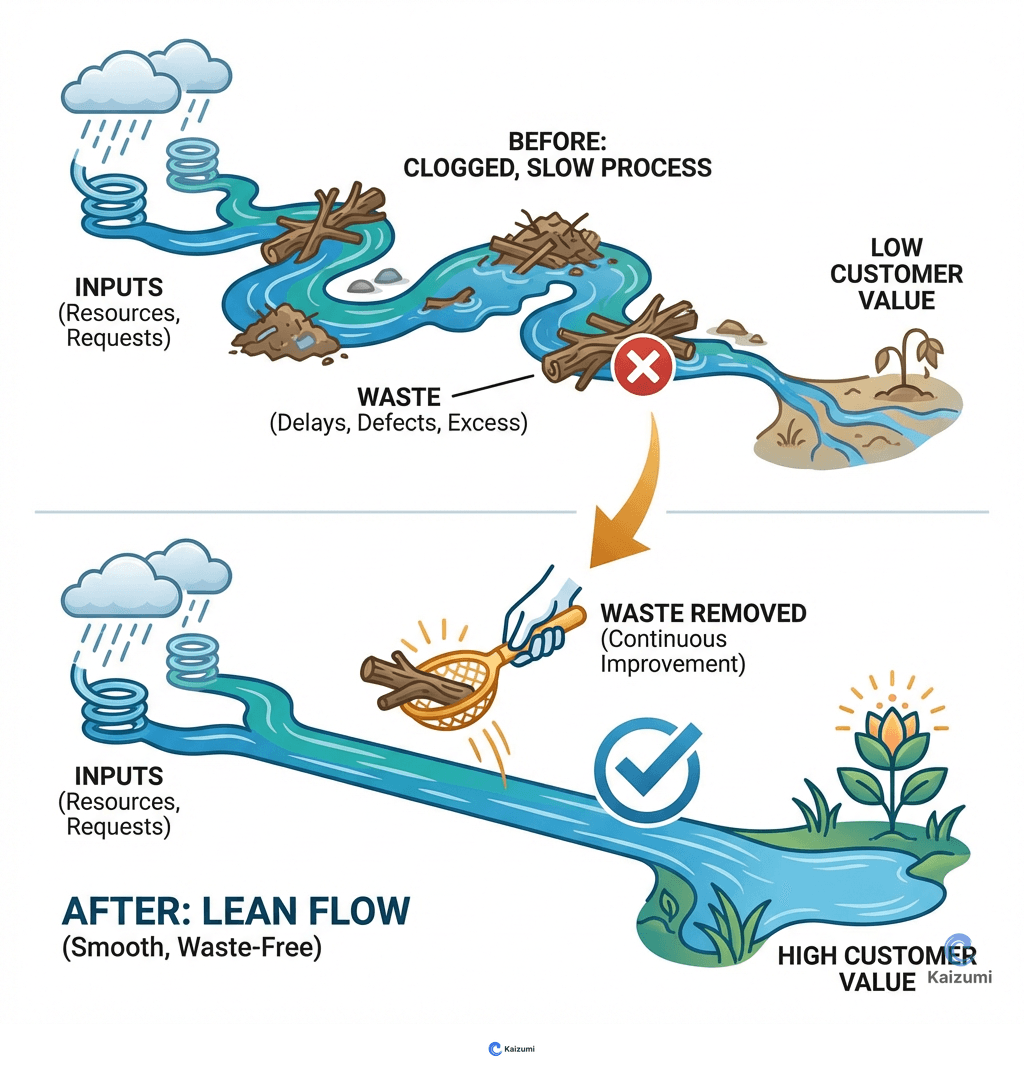
Lean is a methodology for continuous improvement that maximizes customer value while eliminating waste, originating from the Toyota Production System.
Definition
Lean is a systematic approach to identifying and eliminating waste while maximizing value for customers. Originating from the Toyota Production System developed by Taiichi Ohno and Eiji Toyoda, Lean has evolved into a widely-applied methodology used across manufacturing, healthcare, services, and knowledge work. At its core, Lean focuses on understanding what customers truly value, then relentlessly improving processes to deliver that value with minimal waste of time, resources, and human potential.
Examples
A winery applied Lean principles to their bottling line, reducing changeover time from 45 minutes to 12 minutes, eliminating excessive walking through better workstation layout, and creating visual controls so workers could instantly see if production was on track.
Key Points
- Lean is fundamentally about respect for people and continuous improvement working together
- Value is defined strictly from the customer's perspective
- The eight wastes (TIMWOODS) provide a framework for identifying improvement opportunities
- Lean is a journey of ongoing improvement, not a destination
Common Misconceptions
Lean is about cutting costs and headcount. Lean is about eliminating waste, not people. True Lean implementations redeploy workers to value-adding work and improvement activities, not to the unemployment line.
Lean only works in manufacturing. While Lean originated in automotive manufacturing, its principles apply universally to any process that delivers value to a customer.